Category: News

  • (MOU) with the Islamabad Chamber of Commerce

    (MOU) with the Islamabad Chamber of Commerce

    🀝 Exciting Partnership Announcement!

    We are thrilled to share a major milestone for Quaid-e-Azam International Hospital! πŸŽ‰ Today, we have officially signed a Memorandum of Understanding (MOU) with the Islamabad Chamber of Commerce, paving the way for a transformative collaboration between healthcare and business.

    πŸ”Ή What This Means:

    βœ… Strengthening ties between the healthcare and business communities
    βœ… Promoting innovation in medical services and corporate health solutions
    βœ… Enhancing accessibility to top-tier healthcare for businesses and professionals

    This partnership represents our commitment to excellence, innovation, and community well-being. Together, we aim to create a healthier and more prosperous future! 🌟

    πŸ“ Stay tuned for more updates on this exciting collaboration!

    #QIH #HealthcareInnovation #MOU #IslamabadChamber #CollaborationForGrowth


  • Evening Clinics Starting from January 1st 2025

    Evening Clinics Starting from January 1st 2025

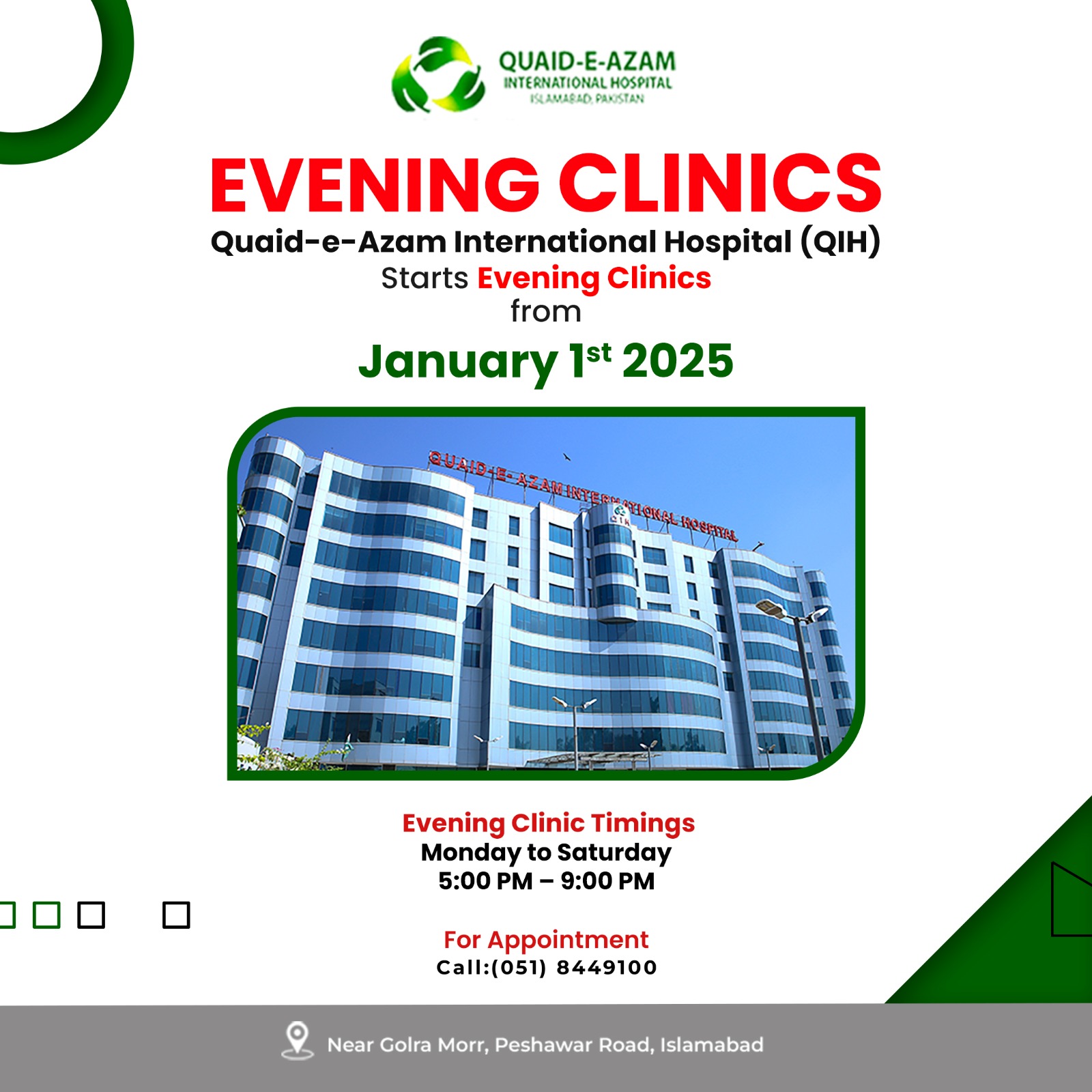
    🌟 Quaid-e-Azam International Hospital Launches Evening Clinics! 🌟

    We are excited to announce that Quaid-e-Azam International Hospital will be starting Evening Clinics from 1st January 2025 to provide convenient healthcare services for our patients.

    πŸ•’ Evening Clinic Timings:

    πŸ“… Monday to Saturday
    ⏰ 5:00 PM – 9:00 PM

    πŸ’‘ Why Choose Our Evening Clinics?

    βœ… Extended Consultation Hours for busy professionals and families
    βœ… Specialist Doctors Available across multiple departments
    βœ… Comprehensive Medical Services with state-of-the-art facilities
    βœ… Easy Appointments & Walk-in Consultations

    πŸ“ Location: Quaid-e-Azam International Hospital, Islamabad

    πŸ”” For Appointments & Inquiries: Call +92 (051) 8449100

    πŸ’™ Your health, our priority – now with extended care!

    #EveningClinics #HealthcareForAll #QIH #ExtendedCare

  • HOUSE JOB – 2025-2026

    HOUSE JOB – 2025-2026

    πŸ₯ House Job Opportunity at Quaid-e-Azam International Hospital πŸ₯

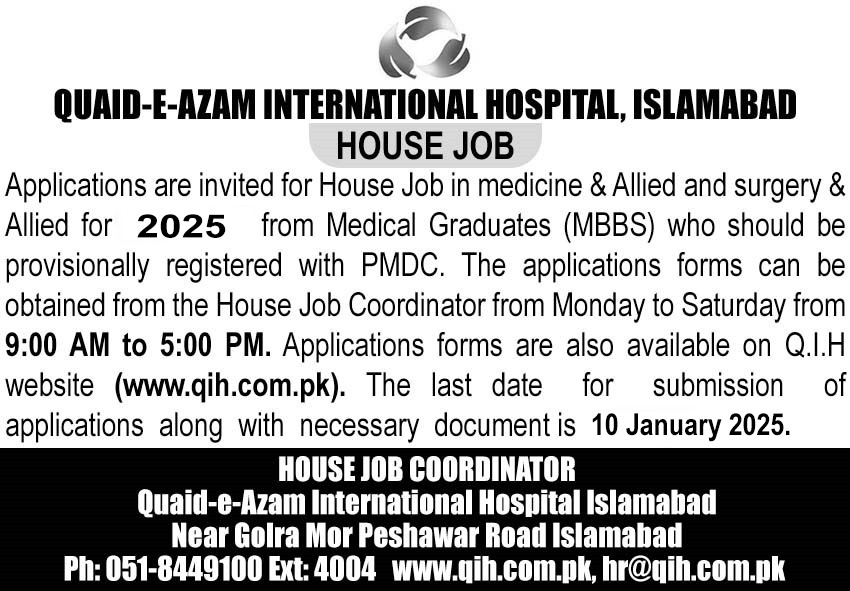
    Are you a fresh medical graduate looking for hands-on clinical experience? Quaid-e-Azam International Hospital (QIH) is offering a House Job Program to help aspiring doctors gain practical knowledge and training under the supervision of experienced healthcare professionals.

    πŸ”Ή Program Details:

    πŸ“ Location: Quaid-e-Azam International Hospital, Islamabad
    πŸ“… Duration:Β 
    πŸ’Ό Departments: Medicine, Surgery, Gynaecology, Paediatrics, Orthopaedics, and more

    πŸ’‘ Eligibility Criteria:

    βœ… MBBS/BDS graduate from a recognized institution
    βœ… Valid PMDC/PMC provisional license
    βœ… Passion for learning and patient care
    βœ… Strong teamwork and communication skills

    🎯 Benefits of the House Job Program:

    πŸ”Ή Practical Clinical Exposure in a well-equipped hospital
    πŸ”Ή Mentorship & Training by senior specialists
    πŸ”Ή Hands-on Experience in diagnosing and treating patients
    πŸ”Ή Certificate upon Completion to boost your medical career

    πŸ“© How to Apply?

    Please Click HereΒ to Download Application Form

    Interested candidates can submit their applications along with their resume, PMC license, and academic transcripts apply in person at the hospital’s HR department.

    πŸ”” Application Deadline: 10 Jan 2025

    πŸ‘‰ Start your medical journey with one of the leading hospitals in Pakistan!

    #HouseJob #MedicalTraining #QIH #HealthcareCareers #MedicalGraduates

  • Alcohol-related deaths up 18% during pandemic

    Alcohol-related deaths up 18% during pandemic

    CSA Z8000 provides guidance on developing a structured, performance-based sustainability program that integrates health care, energy efficiency, and climate change policies and actions in a holistic and coherent manner. By applying sustainability principles, including responsible use of water, energy, and other resources, business continuity, and adaptive capacity, HCFs can have a positive environmental impact.

    • Balancing design approaches with practical realities of northern, small, and remote communities

    Logistical challenges, the harsh climate, building on permafrost, and access to material may make it difficult and expensive for some communities to comply with the requirements of CSA standards. CSA Z8000 recommends using an ethical design framework to engage the community, understand how the HCF can best serve the community, and asses if modifications or adaptations of CSA Z8000 are necessary.

    CSA Z8000:24 aims to lead the health care sector toward sustainability and climate resilience and contribute to better health outcomes and the well-being of patients and health care workers. Visit CSA Group’s website to learn more about CSA Z8000 and other standards and research for HCFs and the complex systems and processes within them.

  • A pathway to independence for patients with rare disease

    A pathway to independence for patients with rare disease

    Nearly 20 years ago, Audrey Gouskos came through the St. Michael’s Hospital Emergency Department unable to walk. She had trouble breathing and would be intubated for six weeks. At 41 years old, with a busy career and a three-year-old son at home, Gouskos recalls having her last rites read as clinicians worked to determine what was going on.

    This was the beginning of her journey with a rare disease known as
    dermatomyositis.

    Β β€œSt. Michael’s has really kept me alive,” says Gouskos.

    Through the years, she has had flare ups that continue to require steroids to manage, been intubated twice, and now has a port for immunotherapy treatment. She has nine specialists at St. Michael’s and visits the hospital five to six times per month because her disease impacts so many different organs.

  • Helping Canada Design Health Care Facilities for Future Needs

    Helping Canada Design Health Care Facilities for Future Needs

    Health care facilities (HCFs) play an important role in communities, providing a safe, secure, accessible, and inclusive space for patients, staff, and visitors. To fulfill this role, they must be designed and built for efficient operation and to respond to the evolving needs of the communities they serve.

    The standard CSA Z8000, Canadian health care facilities, has been providing evidence-based guidance to support the key objectives of HCFs through design for more than ten years. The 2024 edition of the standard builds on this legacy, helping design HCFs for the future, including:

    • Improving the quality of life in long-term care

    CSA Z8000:24 recommends designing long-term care (LTC) homes with consideration for the programs and services they provide. LTC home design should support residents in living to their full capabilities while incorporating the necessary safety and security features. It should promote a home-like, residential-style environment rather than an institutional setting, for example, by creating spaces where residents can congregate, prepare food together, or enjoy a private dinner with their families.

    • Strengthening the climate resilience of health care infrastructure

    CSA Z8000 highlights the importance of integrating climate change resilience in the planning, design, construction, and operation of HCFs to help ensure they can provide continuous service during and after extreme weather events. The standard requires developing and implementing a Climate Resilience Plan, assessing climate-related risks, and adopting climate-resilience measures and strategies, such as using heat pumps, renewable energy sources, or contingency planning for extreme weather and supply shortages, to name a few.